Context
Planning travel is cognitively expensive - comparing transport options, checking hotel availability, reading destination guides, and staying within budget across multiple disconnected platforms. The experience is fragmented, and existing tools don't help you optimise: they present options but don't tell you which combination is cheapest or most convenient.
Objective
Build an end-to-end travel planning platform that uses optimisation algorithms to recommend cost-efficient routes and itineraries, integrates hotel and transport booking, and connects users with travel agents - all through a beautifully designed, responsive interface built in Figma first.
Key Contributions
Route Optimisation Algorithm
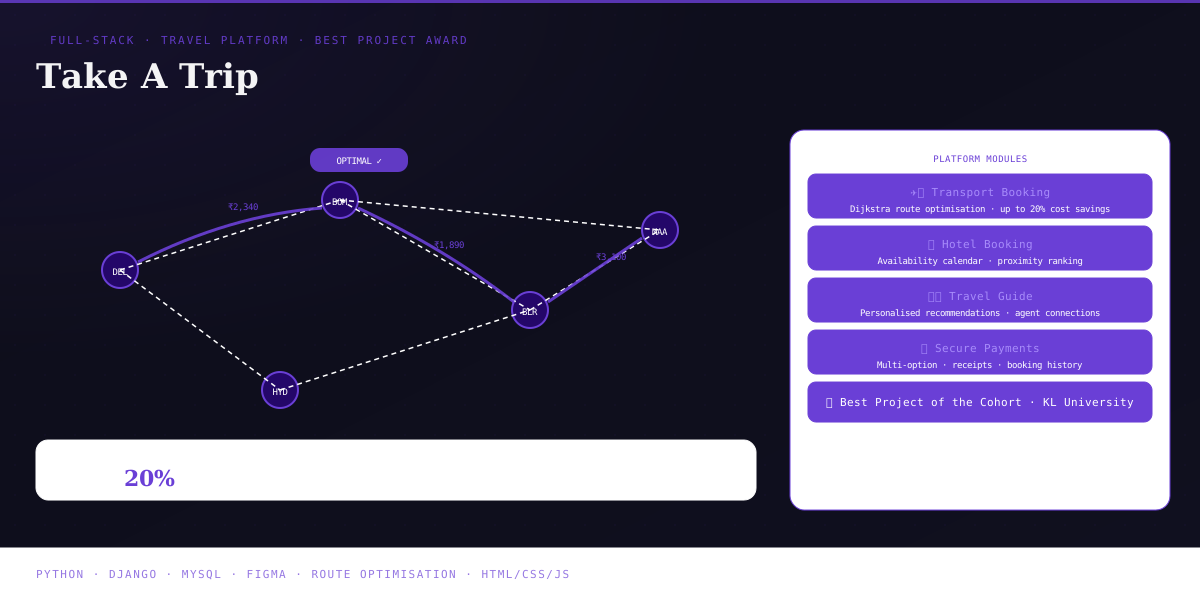
Implemented a shortest-path based optimisation (Dijkstra variant) for multi-modal travel routes. Users input budget, origin, destination, and dates - the algorithm returns the cheapest viable itinerary, achieving up to 20% cost savings vs. booking components separately.
Figma-First UI Design
Designed the entire UI in Figma before writing a line of HTML - user flows, component library, responsive breakpoints. This design-first approach is why the UI was recognised as one of the most polished in the cohort.
Transport Booking Module
Search and booking for flights, trains, and rental vehicles. Results sorted by the optimisation score (cost × convenience), not just price. Users can lock components and re-optimise the rest.
Hotel Booking Module
Hotel search with availability calendar, amenity filters, and proximity to travel hubs. Integrated with the route optimiser - hotels near transfer points are ranked higher for multi-leg itineraries.
Travel Guide & Agent Connection
Destination guides with personalised recommendations based on trip type (adventure, business, family). Direct connection to travel agents for custom itinerary planning - agents can see the user's existing bookings and build around them.
Payment Module
Secure multi-option payment (card, bank transfer) with transaction summaries, receipts, and booking confirmation emails. All booking state persisted in MySQL - cancellation and modification flows included.
Technologies
| Category | Details |
|---|---|
| Language | Python - backend logic, optimisation algorithms |
| Framework | Django - backend, user management, booking logic, responsive frontend |
| Database | MySQL - user profiles, bookings, availability data |
| Frontend | HTML / CSS / JavaScript - responsive Figma-designed UI |
| Design | Figma - full wireframes, component library, prototype |
| Deployment | Render.com - live demo deployment |
Impact
- Best Project of the Cohort - recognised for innovation, design quality, and technical depth
- Route optimisation algorithm delivers measurable cost savings vs. naive component-by-component booking
- Figma-first design process produced significantly better UI than typical academic projects
- All 5 modules (auth, transport, hotel, guide, payment) fully implemented with database persistence
Conclusion
Take A Trip was the project that taught me what separates good software from great software: design thinking before coding, and optimisation that creates real user value. The award validation aside, the project demonstrated that combining algorithmic problem-solving with careful UX design produces something genuinely useful - not just technically functional.